
HDPE chokhat is a new name for many Pakistani homeowners. Some people call it a fibre chokhat, others a plastic or PVC chokhat. In fact, an HDPE door frame is a different product made from a different material. This guide explains what HDPE is, how an HDPE door frame is made and installed, and how it compares with PVC, fibre and wooden chokhats – so you can choose the right frame for your bathrooms, kitchens and rooms.
In this guide
- Why door frames matter
- What is HDPE?
- What is an HDPE door frame?
- UET Lahore test results
- Fibre, plastic or PVC chokhat?
- HDPE vs PVC vs fibre vs wood
- Benefits of HDPE frames
- Where to use HDPE frames
- Sizes and profiles
- Single vs double rebate
- Choosing the right size
- Installation guide
- Compatible doors
- Common buying mistakes
- Questions to ask your supplier
- ASK Framers & Desert Expert
- FAQs
Why the Door Frame Matters in Modern Construction
When a door fails in a Pakistani home, the frame is often the real problem. A wooden chokhat sits in the wall for decades, often touching a floor that is washed every day. In bathrooms and kitchens the bottom of the frame absorbs water, swells, rots and becomes a home for termites. Hinges loosen, the door drops and stops closing properly – and replacing a chokhat means breaking plaster and tiles.
That is why builders and homeowners in Islamabad, Rawalpindi, Lahore, Karachi, Faisalabad and Gujranwala are looking for frames that contain no wood. HDPE door frames are one of the newest options.
What Is HDPE? Understanding High-Density Polyethylene
HDPE stands for high-density polyethylene. It is one of the world’s most widely used plastics, found in water tanks, gas and water pipes, chemical drums and cutting boards. It is called “high-density” because its molecules are packed tightly together, which makes it harder, stiffer and stronger than ordinary polyethylene bags and films.
- Density: about 0.93–0.97 g/cm³ – solid and heavy for a plastic.
- Water absorption: extremely low – around 0.005–0.01% in 24 hours. In simple words, it practically does not soak up water.
- Chemical resistance: very good resistance to dilute acids, alkalis and most cleaning solvents.
- Limits: plain HDPE is weak against long exposure to direct sunlight unless it contains UV stabilisers, and it softens at high temperatures. That is why it is mainly used for indoor door frames.
Material values are typical figures for HDPE from the SpecialChem polymer selection guide. A specific frame’s formulation may differ – ask the manufacturer for its data.
What Is an HDPE Door Frame?
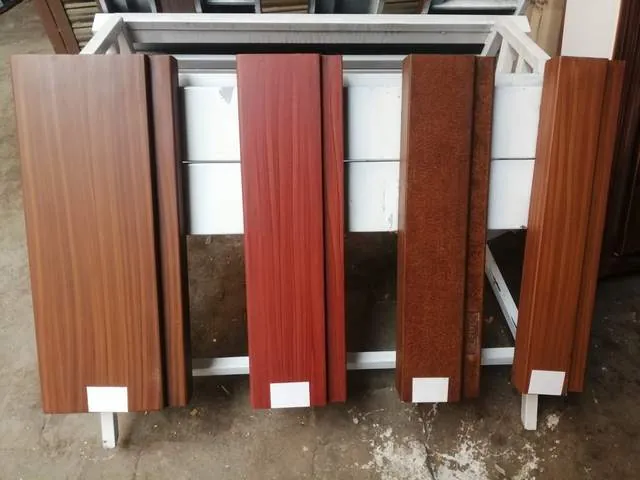
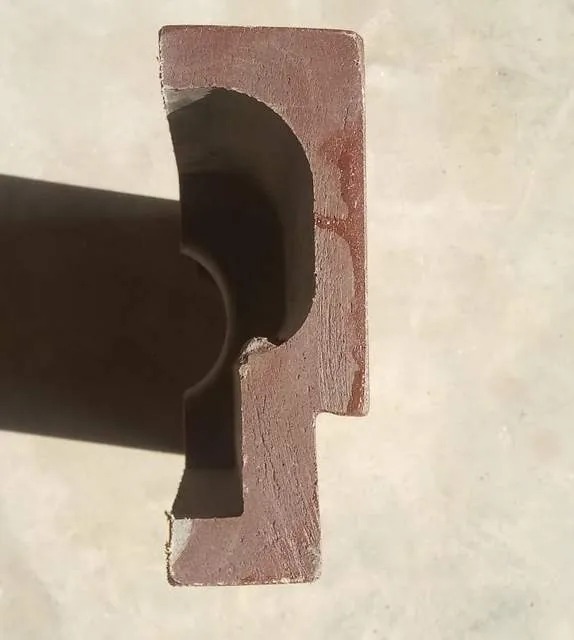
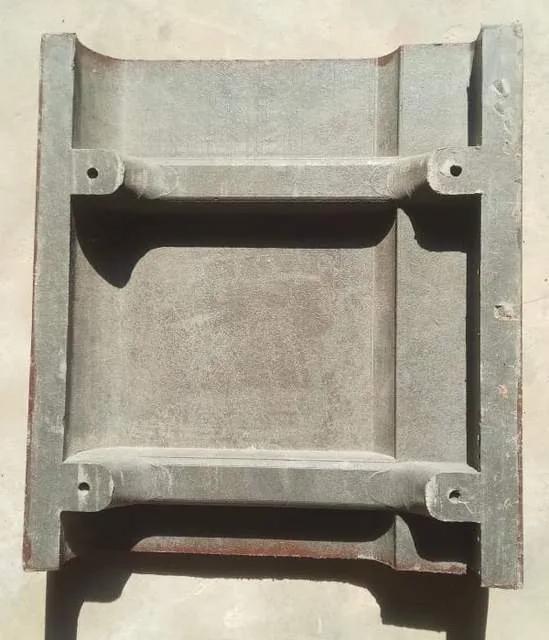
An HDPE door frame is a chokhat (two side members and a top member) moulded from HDPE-based material instead of being cut from timber. The ASK Framers profile supplied by Desert Expert Traders has:
- A solid, rebated front section – the “rebate” (the step the door closes against) is moulded into the profile, just like a wooden chokhat.
- A ribbed back – the side that faces the wall has moulded ribs and fixing points, which keep the frame stiff while saving weight.
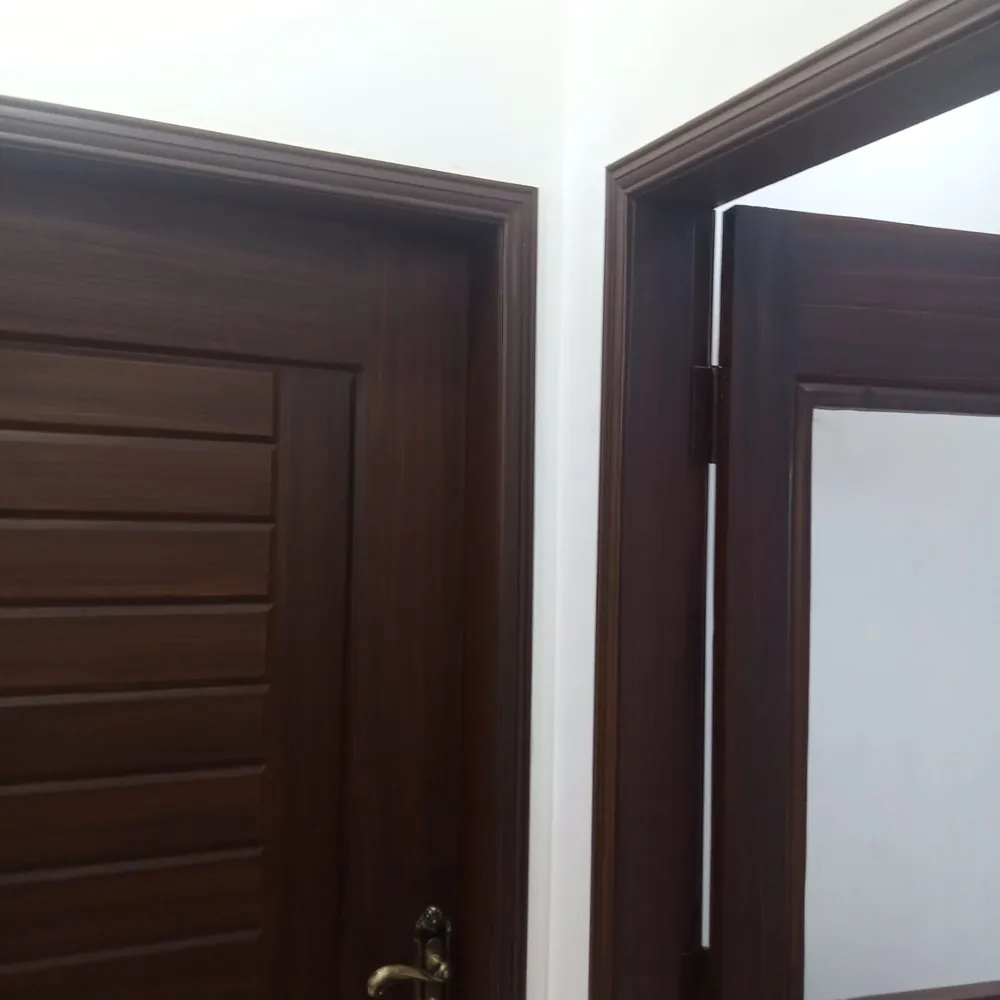
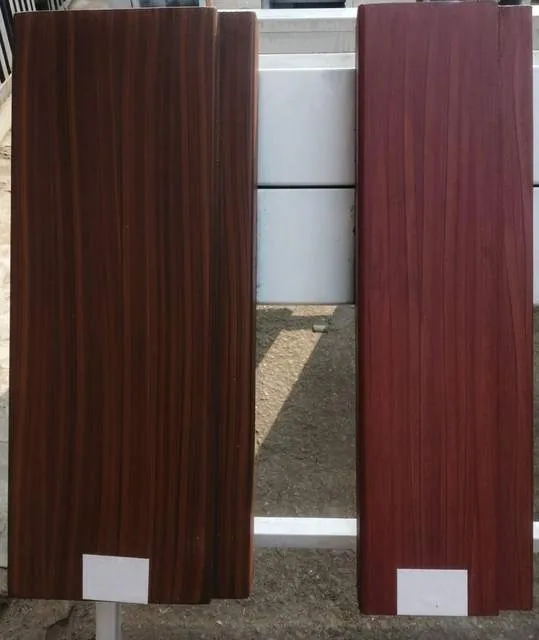
- A wood-grain surface in colours such as walnut and mahogany, with the ASK Framers name moulded into the profile.
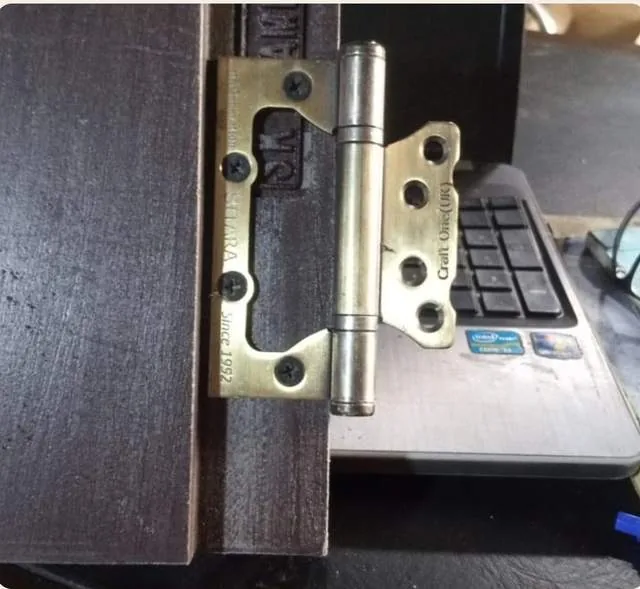
- Standard hinge fixing – hinges are screwed directly into the frame.
Laboratory Test Results – UET Lahore
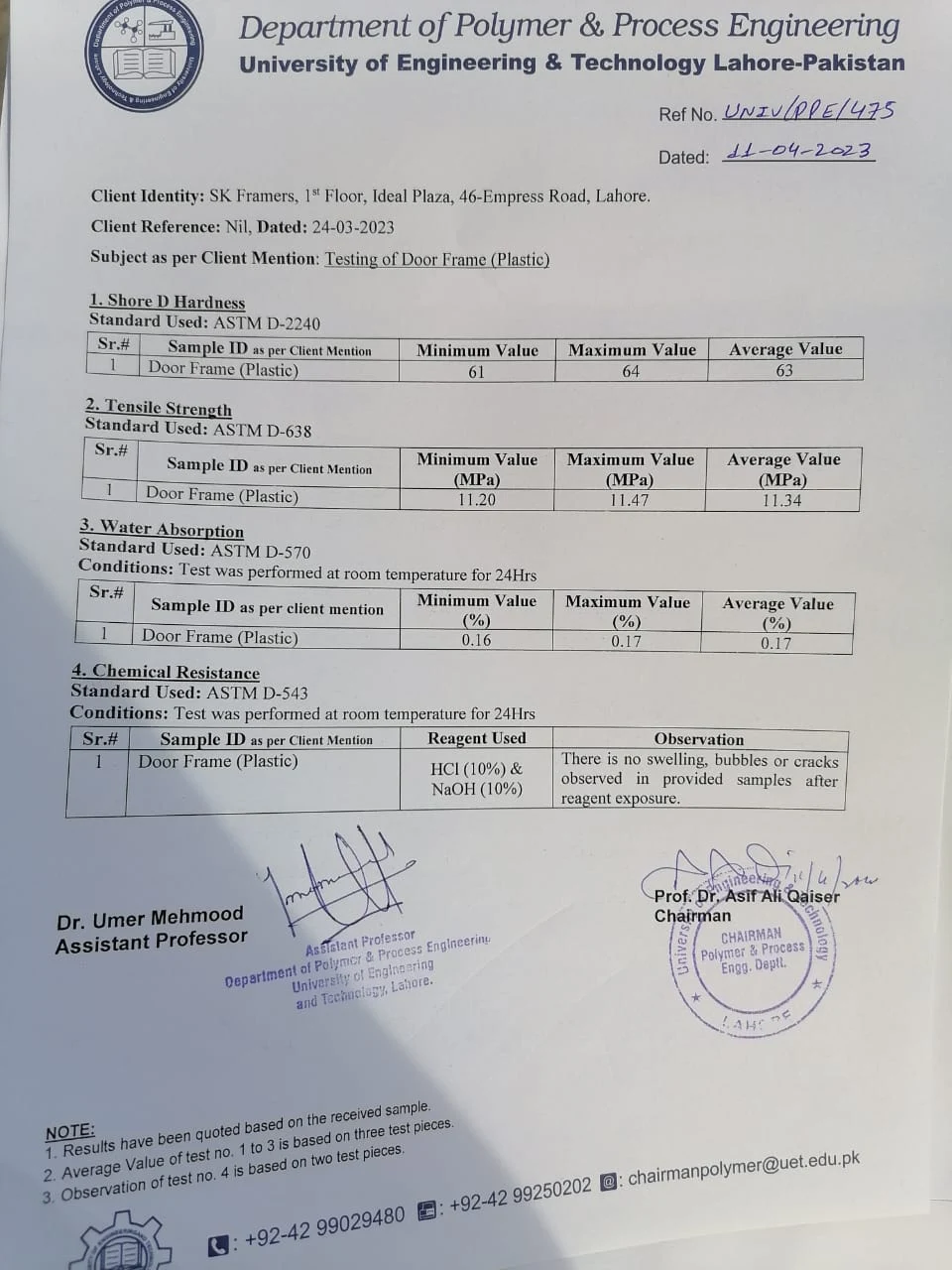
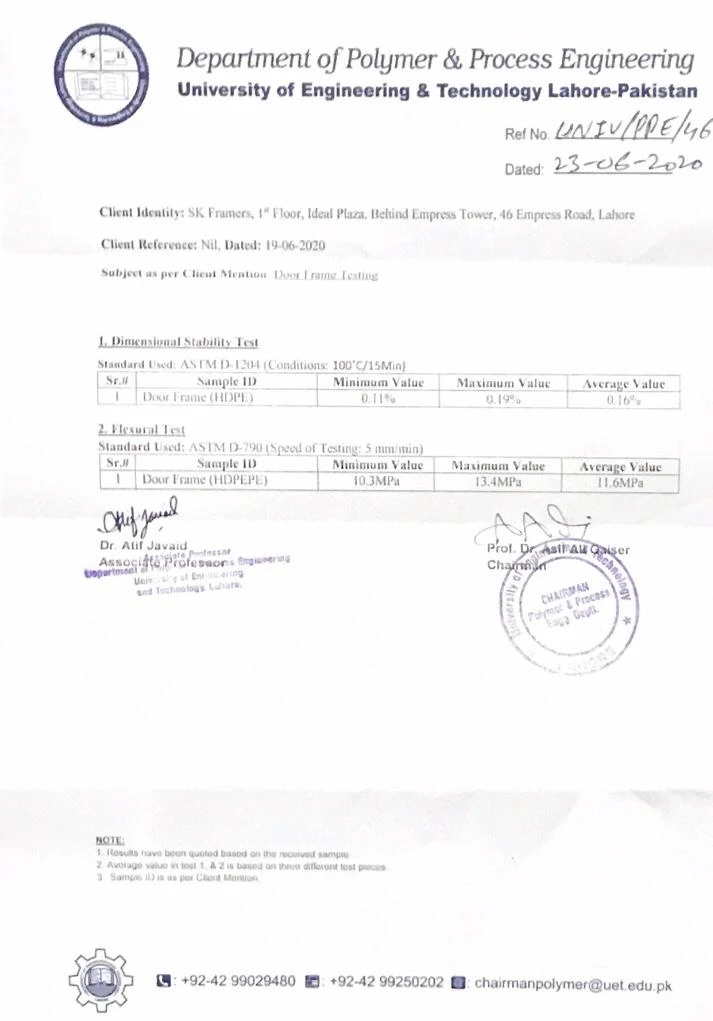
The HDPE door frame has been tested by the Department of Polymer & Process Engineering, University of Engineering & Technology (UET) Lahore. The reports were issued to SK Framers, when SK Framers and ASK Framers operated as one company; the two businesses are now separate.
| Test | Standard | Result (average) | Range | What it means |
|---|---|---|---|---|
| Water absorption (24 h, room temperature) | ASTM D-570 | 0.17% | 0.16 – 0.17% | The frame takes up almost no water |
| Chemical resistance – HCl 10% and NaOH 10% (24 h) | ASTM D-543 | No swelling, bubbles or cracks | – | Resists strong acid and alkali, such as harsh cleaners |
| Shore D hardness | ASTM D-2240 | 63 | 61 – 64 | A hard, rigid plastic surface |
| Tensile strength | ASTM D-638 | 11.34 MPa | 11.20 – 11.47 MPa | Resistance to being pulled apart |
| Flexural strength | ASTM D-790 | 11.6 MPa | 10.3 – 13.4 MPa | Resistance to bending |
| Dimensional stability (100 °C, 15 min) | ASTM D-1204 | 0.16% change | 0.11 – 0.19% | Keeps its size when heated |
Sources: UET Lahore report Ref. UNIV/PPE/475 dated 11-04-2023 (hardness, tensile, water absorption, chemical resistance) and Ref. UNIV/PPE/46 dated 23-06-2020 (dimensional stability, flexural strength). As stated on the reports, results apply to the samples received for testing.
Is HDPE a Fibre Chokhat, Plastic Chokhat or PVC Chokhat?
In the market you will hear all of these names. Here is what they actually mean:
| What people call it | What it really is | Same as HDPE? |
|---|---|---|
| Fibre chokhat / FRP frame | Glass fibre mat bonded with resin (fibre-reinforced plastic) | No – different material |
| PVC chokhat / plastic chokhat | Polyvinyl chloride, often a hollow box profile | No – different plastic |
| WPC frame | Wood-plastic composite: wood flour mixed with plastic | No – contains wood fibre |
| Waterproof chokhat | A marketing description, not a material | Depends on the product |
| HDPE chokhat | High-density polyethylene, moulded profile | Yes |
So an HDPE chokhat is a plastic frame, but not a PVC frame, and it is not fibre (FRP). It is fine to call it a “plastic chokhat” as long as you remember that plastics are very different from each other.
HDPE vs PVC vs FRP/Fibre vs Wooden Door Frames
| Material | Water resistance | Termite resistance | Rot resistance | Maintenance | Main considerations |
|---|---|---|---|---|---|
| HDPE | Very high – absorbs almost no water | High – no cellulose for termites | Does not rot | Low; usually painted or polished once to match the door | Quality depends on formulation and profile design; keep away from direct heat and long sun exposure |
| PVC | High – PVC itself does not absorb water | High | Does not rot | Low | Many low-cost chokhats are hollow; screw holding and stiffness vary; cheap grades can turn brittle or yellow |
| FRP / Fibre | High when well made and sealed | High | Does not rot if fully sealed | Low | Quality depends on resin, glass content and finishing; some products use a wooden or filler core |
| Wood | Low – absorbs water unless sealed and maintained | Low – termites feed on wood | Rots in wet areas | High – needs polish and anti-termite treatment | Strong and familiar, easy to repair; best kept for dry rooms |
No frame material is perfect in every situation. Real-world performance depends on the material formulation, manufacturing quality, profile design and installation. A well-made frame of any material, installed properly, will outperform a poor one.
Main Benefits of HDPE Door Frames
Water and moisture resistance
HDPE absorbs almost no water – the frame tested at just 0.17% water absorption in 24 hours at UET Lahore – so the bottom of the frame does not swell, soften or rot where it meets a wet bathroom or kitchen floor. This is the single biggest reason to choose it.
Termite resistance
Termites feed on cellulose – the natural fibre in wood. HDPE contains no wood or cellulose, so it gives termites nothing to eat. This makes it a strong choice for ground floors and termite-prone areas.
No rot and no rust
Being a plastic, HDPE does not rot like timber or rust like a steel chokhat. Use stainless or brass-finish hinges and screws so the hardware lasts as long as the frame.
Low maintenance
There is no need for repeated anti-termite treatment or re-polishing because of water damage. Clean the frame with a damp cloth. As with any frame, avoid scraping it with sharp tools or placing heaters right against it.
Clean installation
HDPE frames are fixed with screws after plastering, without cement filling behind them, so installation is quicker and neater.
Replacing rotten bathroom chokhats? Send us your door sizes and wall thickness and we will quote HDPE frames cut to your openings.
WhatsApp for a QuotationWhere Can HDPE Door Frames Be Used?
- Bathrooms and washrooms – the most important use.
- Kitchens and laundry areas where floors are washed often.
- Ground-floor rooms in termite-prone areas.
- Bedrooms and lounges – for a matching frame throughout the house.
- Offices, schools, hospitals, mosques and hostels with heavy cleaning.
- Renovation projects where old wooden chokhats have rotted.
HDPE frames are designed for internal doors. For main entrance doors exposed to strong sun and rain, ask us whether the profile and finish suit that location.
HDPE Door Frame Sizes and Profiles
| Opening width | Heights available |
|---|---|
| 2.5 ft | 6.5 ft · 7 ft · 8 ft |
| 3 ft | 6.5 ft · 7 ft · 8 ft |
| 3.25 ft | 6.5 ft · 7 ft · 8 ft |
| 3.5 ft | 6.5 ft · 7 ft · 8 ft |
| 4 ft | 6.5 ft · 7 ft · 8 ft |
| 5 ft | 6.5 ft · 7 ft · 8 ft |
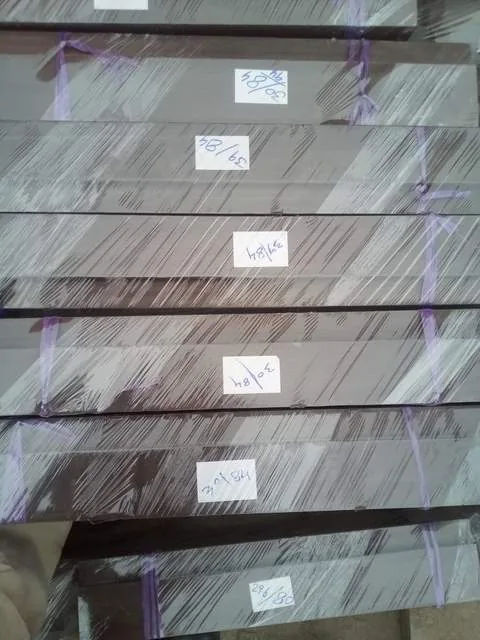
Profiles (wall thickness): 5″, 5.5″ and 10″, in single and double designs. Custom sizes are made to order. Frames are delivered size-labelled for each opening.
Single Rebate vs Double Rebate
The rebate is the step in the chokhat that the door closes against. It stops the door from swinging through and helps it close neatly.
- Single rebate – one step on one side. Used for a normal single door: bedrooms, bathrooms, kitchens.
- Double rebate – steps on both sides. Used where a second shutter is needed (for example a door plus a jali or mesh door), or where the door must be hung from the other face of the wall. Tell us how the door should open and we will advise.
How to Select the Correct Frame Size
- Measure the finished wall thickness after plaster – this decides the profile (5″, 5.5″ or 10″).
- Measure the opening – width and height in feet and inches.
- Check the door thickness – DEX fiber doors are 1.5″; the rebate must suit your door.
- Decide the hinge side and swing direction – left or right, inward or outward.
- Single or double rebate? – one door or two shutters.
- Count each size and send the list to us – frames are labelled per opening.
Not sure about your wall thickness or sizes? WhatsApp us a photo of the opening with a measuring tape and our team will help.
Send Sizes on WhatsAppHDPE Door Frame Installation Guide
- Finish the plaster first. HDPE frames are fitted after plastering, not built into the brickwork.
- Cut to size. The frame members are cut to the exact opening.
- Place and align. Set the frame in the opening and check it is straight and level with a spirit level.
- Fix with screws. Fix through the frame into the wall using 4-inch screws and rawl plugs.
- Fill the gaps with PU foam. The gap between frame and wall is filled with PU foam spray – no cement or concrete filling behind the frame.
- Hang the door. Fix standard hinges directly to the frame and hang the door.
Installation is available from our team in Islamabad and Rawalpindi. For other cities we supply frames cut to size and can guide your carpenter.
Compatibility with Fiber, Wooden and Other Doors
Because HDPE frames take standard hinges, they can carry DEX fiber doors, solid wooden doors, WPC doors and flush doors. Make sure the rebate depth matches your door thickness and the hinges suit the door weight.
For bathrooms, the best combination is a full fiber door with an HDPE frame – an opening with no wood at the floor line. Read more in our bathroom fiber door price guide.
Common Mistakes When Buying Door Frames
- Calling every plastic frame “the same”. HDPE, PVC, WPC and FRP behave differently – ask what the frame is actually made of.
- Choosing by price per foot only. A hollow, thin profile is cheaper but may hold screws and hinges poorly.
- Ordering before plastering is finished. Wall thickness changes after plaster – measure the finished wall.
- Wrong profile for the wall. A 5″ frame on a thicker wall leaves gaps that look bad and weaken fixing.
- Filling behind with cement. HDPE frames are fixed with screws and PU foam; follow the supplier’s method.
- Cheap hinges and screws. Rusting hardware ruins a frame that would otherwise last.
- Fitting a waterproof frame with a wooden door in a bathroom. The door will still swell – pair the frame with a water-resistant door.
Important Questions to Ask Your Supplier
- What exactly is the frame made of – HDPE, PVC, WPC or FRP?
- Is the profile solid or hollow? Can I see a cut sample?
- Which wall thicknesses and rebate types do you stock?
- How is it fixed, and do you provide installation?
- Does it need paint or polish on site?
- What warranty do you give, and is it written in the quotation?
- Do you cut frames to size and label them per opening?
- Do you deliver to my city, and what does transport cost?
Why Choose ASK Framers HDPE Door Frames?
ASK Framers is the manufacturer of these HDPE door frames. Their profile is moulded with the door rebate built in and a ribbed back for fixing, finished in wood-grain colours and marked with the ASK Framers name, so you can recognise a genuine frame on site.
Desert Expert Traders – Your Supply Partner in Pakistan
Desert Expert Traders (Pvt) Ltd is an SECP-registered company based in Bahria Town Phase 8, Islamabad, and an authorised distributor of ASK Framers HDPE door frames. We do not manufacture the frames – we supply them, cut to your sizes, and install them in Islamabad and Rawalpindi. We also manufacture DEX fiber doors in our own Gujranwala facility, so we can supply a complete door and frame together.
- Advice before you buy – we help you choose the right profile and rebate.
- Cut to size and labelled for each opening.
- Installation in Islamabad and Rawalpindi; delivery across Pakistan.
- Door + frame from one supplier – see our HDPE door frames range.
Related guides
Frequently Asked Questions
Has the HDPE door frame been lab tested?
Yes. UET Lahore’s Department of Polymer & Process Engineering tested the frame for water absorption (0.17% in 24 hours), acid and alkali resistance (no swelling, bubbles or cracks), hardness, tensile and flexural strength, and dimensional stability. The reports were issued to SK Framers when SK Framers and ASK Framers were one company.
What is an HDPE door frame?
An HDPE door frame is a chokhat made from high-density polyethylene, a dense plastic that absorbs almost no water. It replaces the traditional wooden chokhat and is fixed to the wall with screws and rawl plugs.
Is an HDPE chokhat the same as a fibre chokhat?
No. Fibre (FRP) frames are made of glass fibre and resin. HDPE frames are made of high-density polyethylene. They look similar once finished, but they are different materials.
Is HDPE the same as PVC?
No. HDPE (high-density polyethylene) and PVC (polyvinyl chloride) are different plastics. Many cheap PVC chokhats are hollow box profiles; the ASK Framers HDPE profile is a moulded, rebated section with a ribbed back for fixing.
Do termites eat HDPE door frames?
Termites feed on cellulose, which is found in wood. HDPE contains no wood or cellulose, so it gives termites nothing to feed on. This is why HDPE frames are used to replace wooden chokhats in termite-prone areas.
Can HDPE door frames be used in bathrooms?
Yes. Bathrooms are the main reason people switch to HDPE. HDPE absorbs almost no water, so the bottom of the frame does not rot or swell where it touches a wet floor.
Which sizes are available?
Desert Expert supplies standard openings from 2.5 × 6.5 ft to 5 × 8 ft, in profiles for 5″, 5.5″ and 10″ walls, single and double. Custom sizes are made to order.
How is an HDPE frame installed?
After the wall is plastered, the frame is cut to size, aligned, fixed with 4-inch screws and rawl plugs, and the gaps are filled with PU foam. No cement filling is needed behind the frame.
Can I fit a wooden door on an HDPE frame?
Yes. HDPE frames take standard hinges, so they can carry fiber, wooden, WPC or flush doors. Tell us your door thickness so the rebate matches.
Do HDPE frames need paint or polish?
Frames come in wood-grain colours. Like a wooden chokhat, they are usually given a final paint or polish coat on site so they match the door. Ask us which finish suits your door.
Conclusion
An HDPE chokhat is not a fibre frame and not an ordinary PVC frame. It is a moulded high-density polyethylene frame that absorbs almost no water and gives termites nothing to eat – which is exactly what Pakistani bathrooms, kitchens and ground floors need. Choose the right profile for your wall, install it the right way, and pair it with a water-resistant door for a frame you will not need to replace.
AUTHORISED DISTRIBUTOR · ASK FRAMERS HDPE DOOR FRAMES
Get an HDPE door frame quotation
Send your door sizes, wall thickness and number of frames on WhatsApp. We reply with a written quotation, including installation in Islamabad and Rawalpindi or delivery to your city.
Get HDPE Frame Price on WhatsApp View HDPE Frames Range DEX Fiber Doors
Source for HDPE material data: SpecialChem – Polyethylene (PE) selection guide.